Welcome to our Tanztheater Course
We will explore the areas of Tanztheater in four blocks.
→ Theory
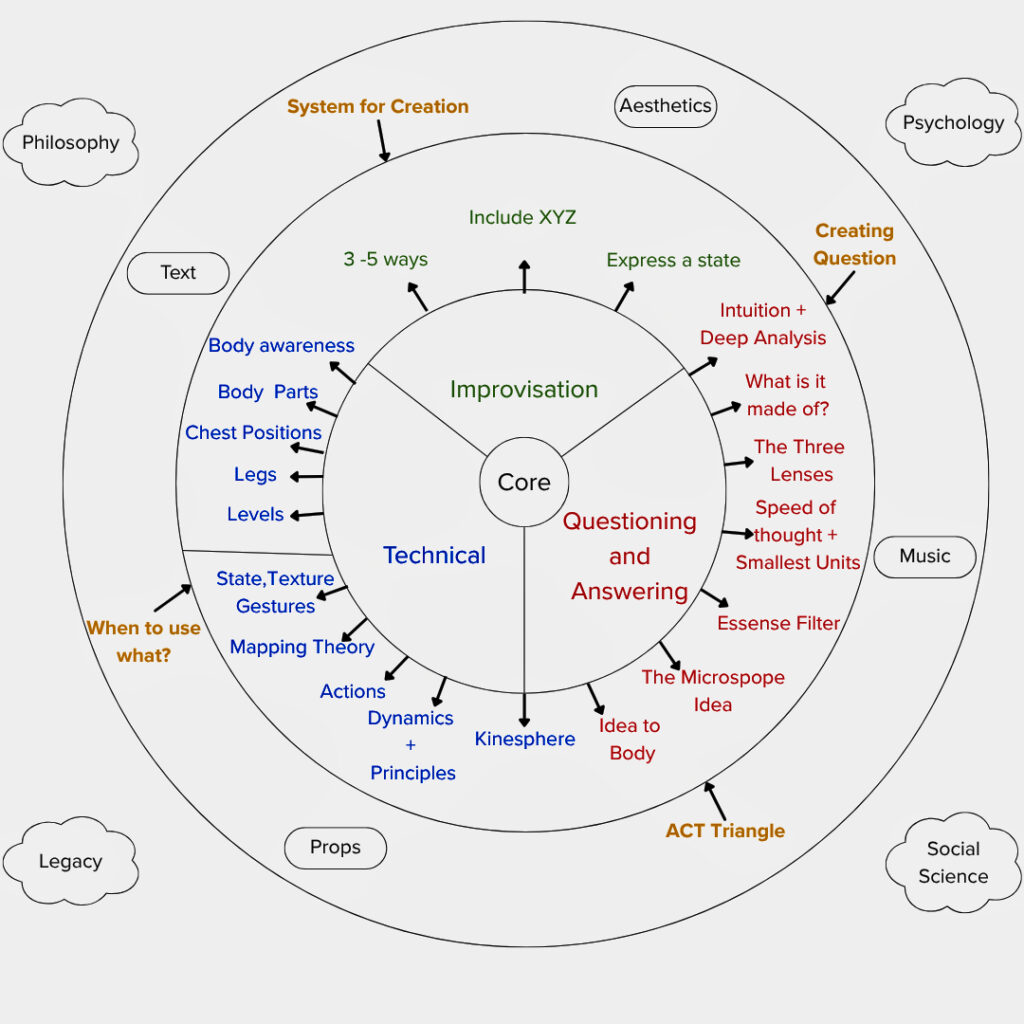
By the end of this course you should be able to make sense of all elements of this circular model:
Quick Links
🔵
Technical
• Body awareness • Body parts • Chest positions • Legs • Levels
• State, Texture, Gestures • Mapping theory • Actions • Dynamics + Principles • Kinesphere
🟢
Improvisation
• 3–5 ways • Include XYZ • Express a state
🔴
Questioning and Answering
• Intuition + deep analysis • What is it made of? • The three lenses
• Speed of thought + smallest units • Essence filter • The microscope idea • Idea to body
🟠
Theory
System for Creation • Creating Questions • When to use what? • ACT Triangle
Technique
Body Awareness
Everything begins with awareness. Below are a few areas that help you deepen your understanding of your own body and a simple exercise to practise to
→ Feel the skin
→Sense the beginning and end of a body part
→ Understand how joints, muscles and bones relate to one another
→ Tune into the space surrounding you
Body Parts
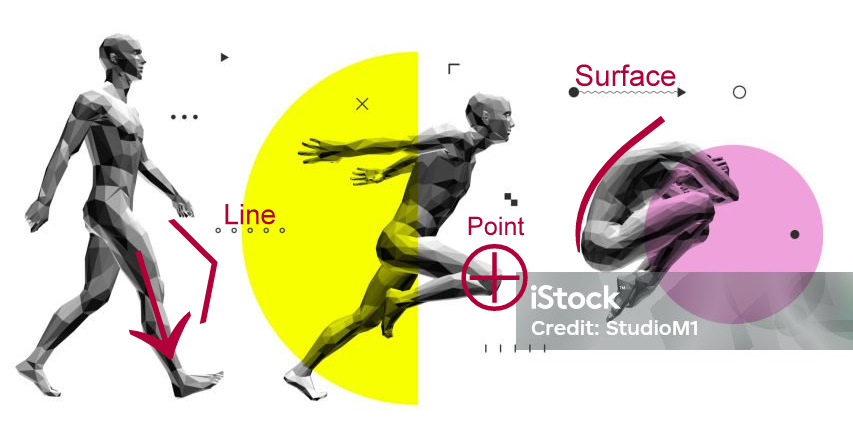
It can be very helpful to think about these three different body parts when creating:
→ Points
→ Lines
→ Surfaces
How it works
Points are direct, staccato and quick.
Lines are dividing or slicing the space.
Surfaces are slower, heavier and stronger.
Chest Postitions
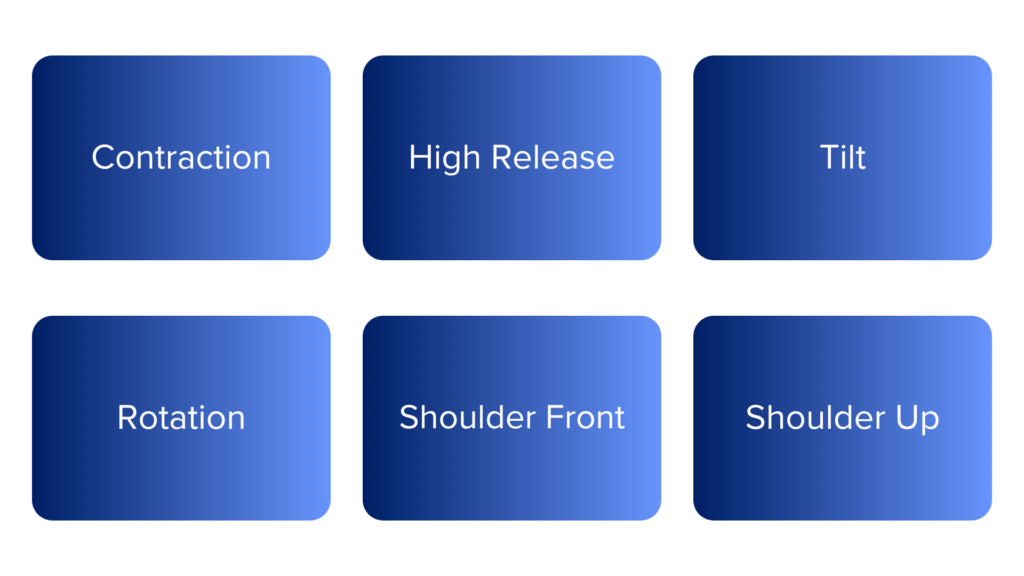
The following six positions are crucial for expressing the emotional range of raw physical states.
How it works
| Contraction | Heavy | Burdened | Tired | Exhausted | Smaller (Hedgehog) |
| High Release | Hopeful | Reaching | Sun kissed | Blessed | Taller |
| Tilt | Side plane | Out of balance | Falling | Takes you into space |
| Rotation | Around spine | Circular | Wringed | Future & Past |
| Shoulder Front | Restricted | Escaping | Only way is out & forward | Initiator |
| Shoulder Up | Restricted | Elevating | Twisted way out | Grow against |
Legs
There are, of course, many ways to use the legs, but the positions below are commonly used in Tanztheater. They provide stability and support for upper‑body movement while also creating a varied architectural structure in the body..
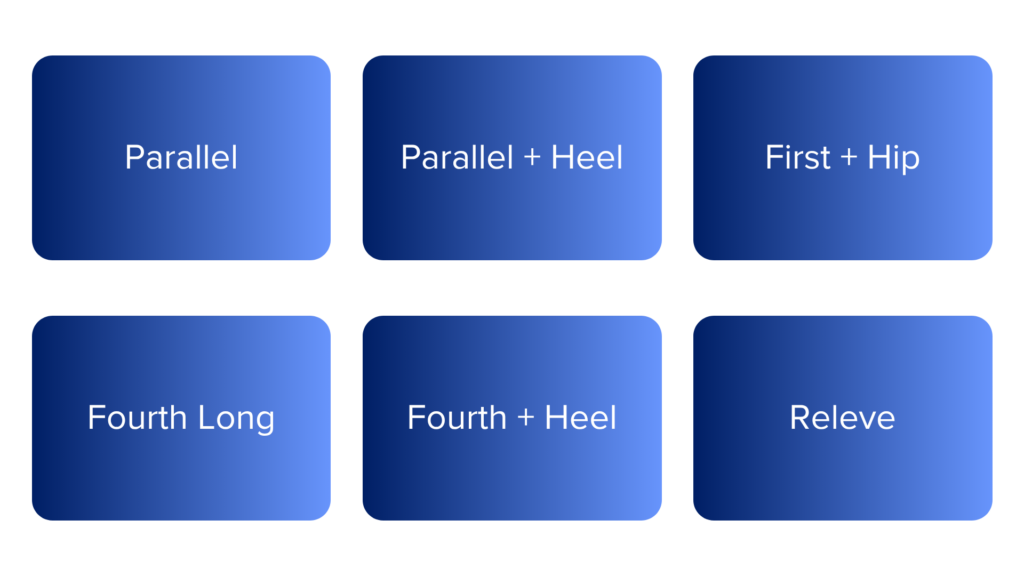
Here is a short demonstration of how these positions might look like in a phrase or exercise:
Levels
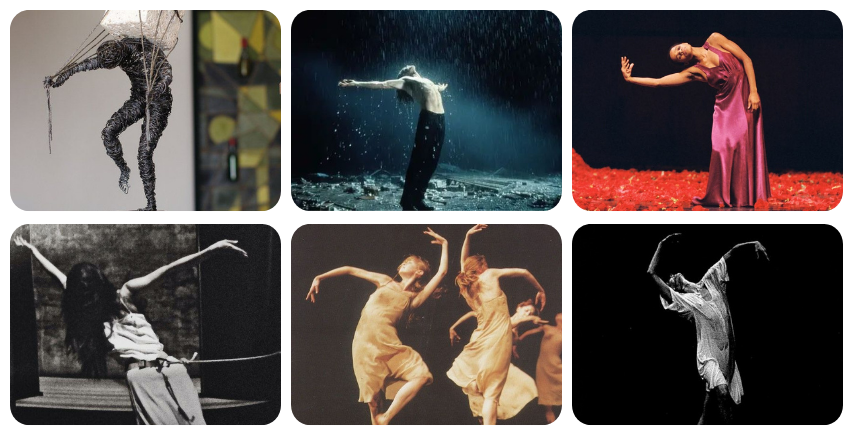
Using different levels when creating material helps generate a broader range of situations that feel relatable to an audience.
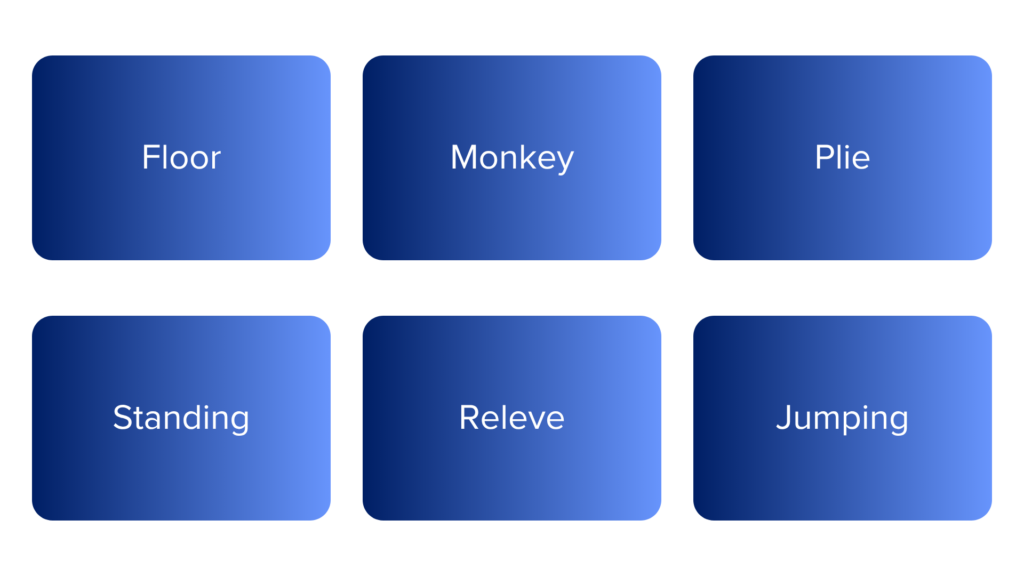
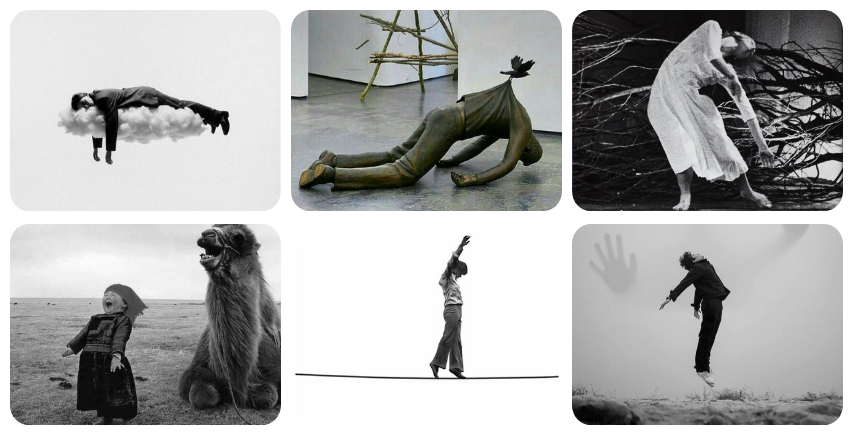
Here is a collage to illustrate how different these positions feel and which kind of imagery they can create:
Arms
~
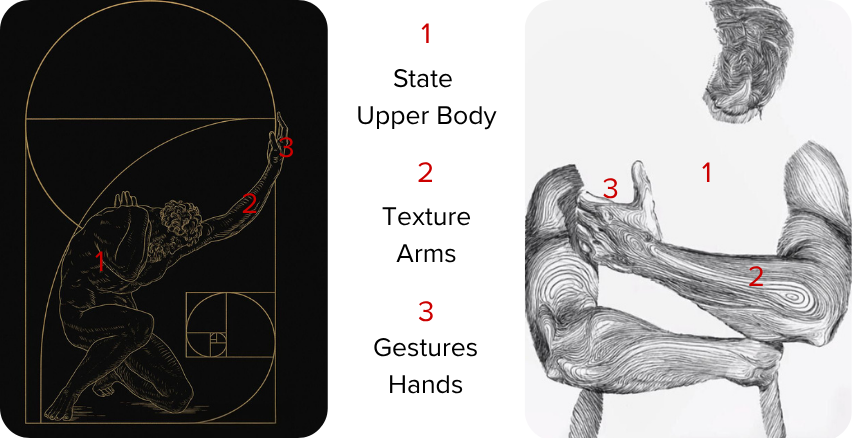
State, Texture and Gestures
Arm movements play an essential role in the Tanztheater aesthetic, so here is a breakdown of the different ways the arms can be used and how each relates to the chest positions:
→ State
→ Texture
→ Gestures
First, let’s look at where these three elements live in the body:
Enhancing vs Aesthetic
The upper body and chest continue to hold the primary state, while the arms can be divided into two main categories, each with its own distinct relationship to that state:
→ Enhancing
→ Aesthetic
How it works
Enhancing movements are arm movements performed within or around the spatial area proposed by the upper body. They amplify or reinforce the state already present.
Aesthetic movements are arm movements performed in the opposite direction or outside the area proposed by the upper body. Their purpose is to create a more pleasing or intentional architectural shape in the body.
It’s important to note that aesthetic or architectural movements can still carry meaning and express an emotional state. However, this meaning will stand in contrast to the state proposed by the upper body rather than aligning with it.
Here are two examples to illustrate:
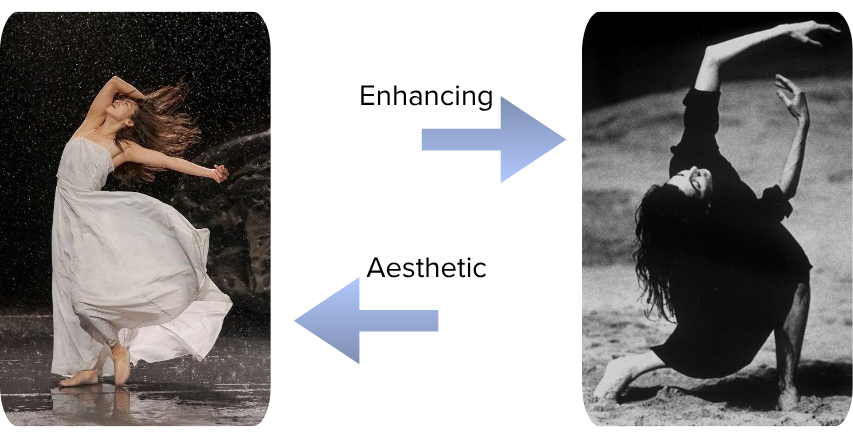
Inviting vs Pushing
Another helpful tool is to vary the muscle tension and the relationship between the body and the arms to create either a sense of fluidity or a more held‑back tension in the body.
→ Inviting
→ Pushing
How it works
Inviting movements are movements in which the shoulders and upper body create space first, allowing the arms to enter that space. This sequence generates high fluidity and speed, as the body opens and the arms follow.
Pushing movements are movements in which the arms initiate the action, with the shoulders and upper body responding to the force that the arms create. These movements are highly effective for expressing restriction or struggle, as the resulting tension produces slower, heavier, and more powerful dynamics.
Gestures
Gestures are used to “speak” about an observation or experience in a language refined enough to convey meaning, yet subtle enough to avoid slipping into pantomime. They are reflective by nature and can offer a witty, playful, or poetic account of a past event or scenario.
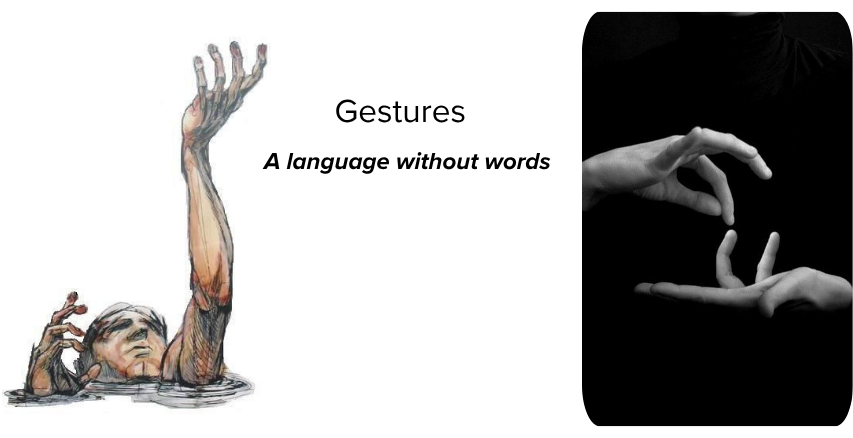
How it works
Gestures are often
→ everyday movements such as tucking your hair behind your ear, brushing dust off your clothes, or “washing” your face or neck
→ manipulations, brushes, flicks, or other forms of touch
→ abstracted symbols or metaphors, like playing with rain or letting sand trickle through your fingers as a metaphor for time passing
→ used within the reflected approach to present a detailed memory to the audience
Mapping Theory
Another way to generate movement is by mapping the body—much like a simplified form of motion capture—and assigning qualities or attributes to any of the mapped points.
The strength of this approach lies in the heightened awareness it creates: focusing on specific points activates neural pathways, deepens embodiment, and brings greater clarity and precision to the movement.
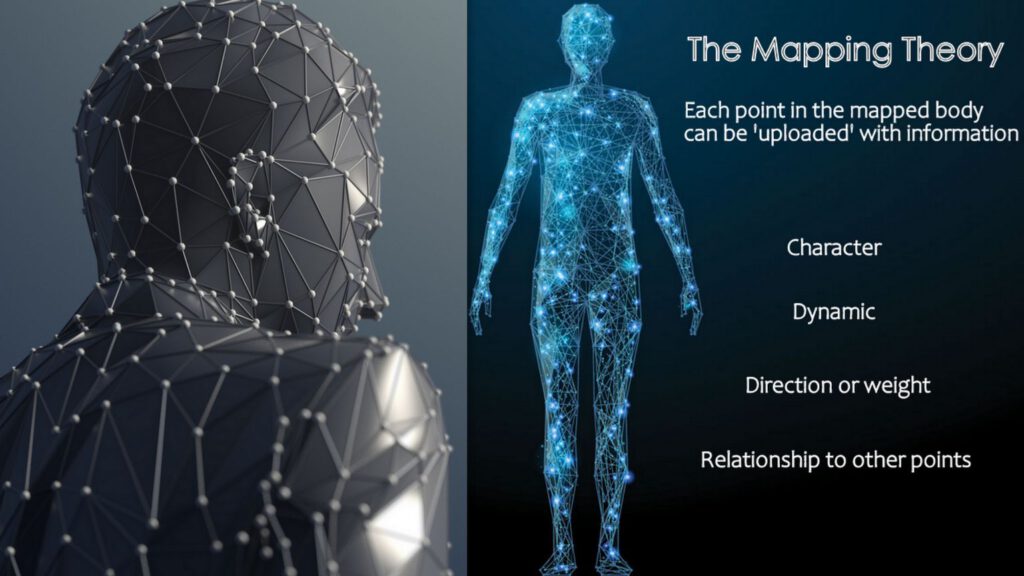
How it works
| Mapped points | Uploaded information |
Three points on your right wrist, connected with silk to the left upper corner of the studio | Three spiders slowly pull in your wrist |
| One point in the centre of your nose | A heavy stone connected to the point drops |
| 15 points spread over your back | All 15 points try to collect rain water, then shake off the rain in one go |
| Five points each on both arms | 150 butterlies connected via fine threads are lifting both of your arms |
| Two points on each of the top of the fingertips of your left hand + 10 points on your right ribcage | All 10 points of your left fingertips are wandering through the space until they find the 10 points on your ribcage |
Actions
Tanztheater seeks to give form to emotional states, and because emotions are layered, shifting, and often contradictory, the movement language must be equally diverse and nuanced.
The actions below offer ways to tap into the more unfiltered, visceral side of emotional expression:
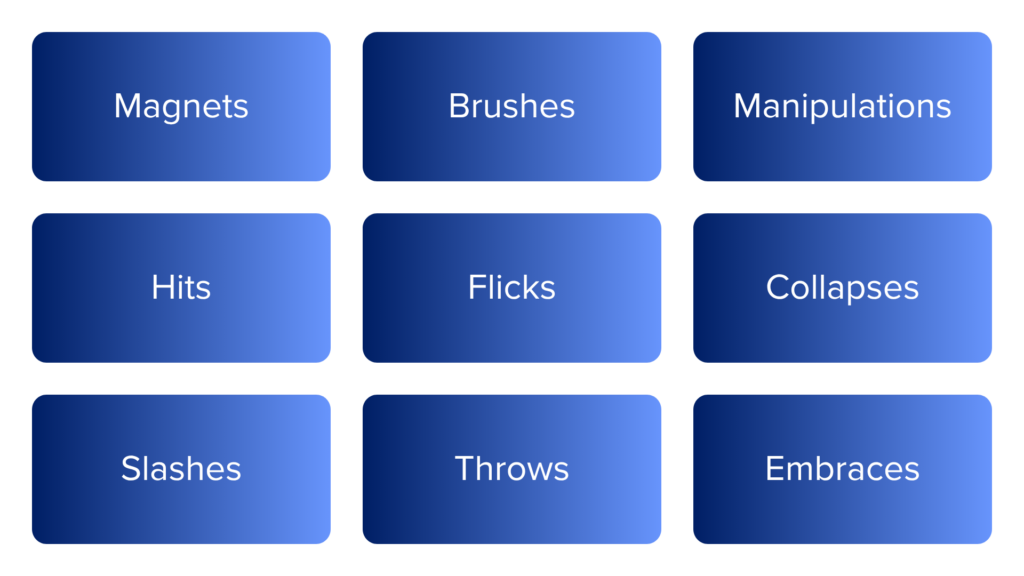
Here is a short demonstration of how these Actions might look like in a phrase or exercise:
Dynamics
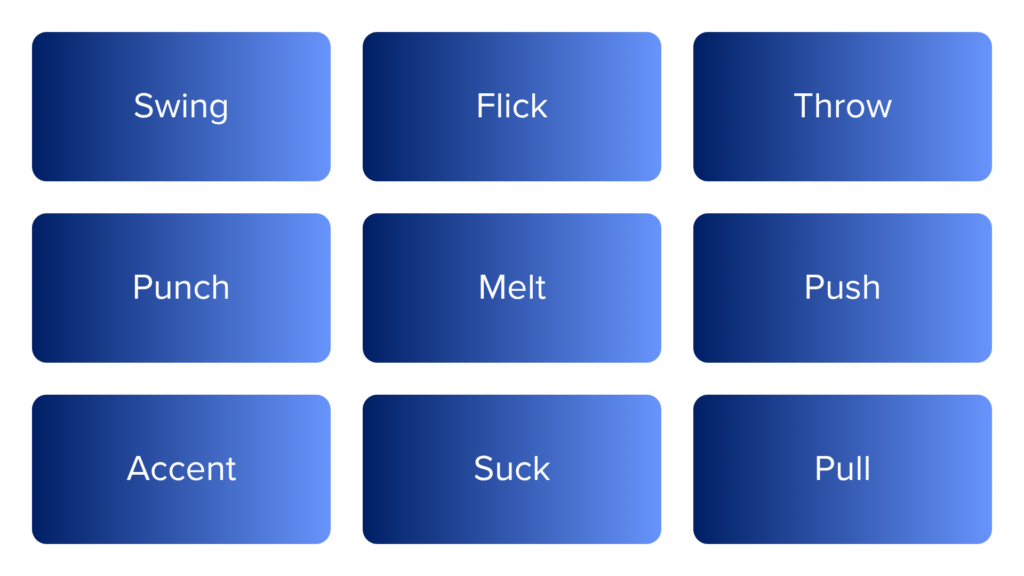
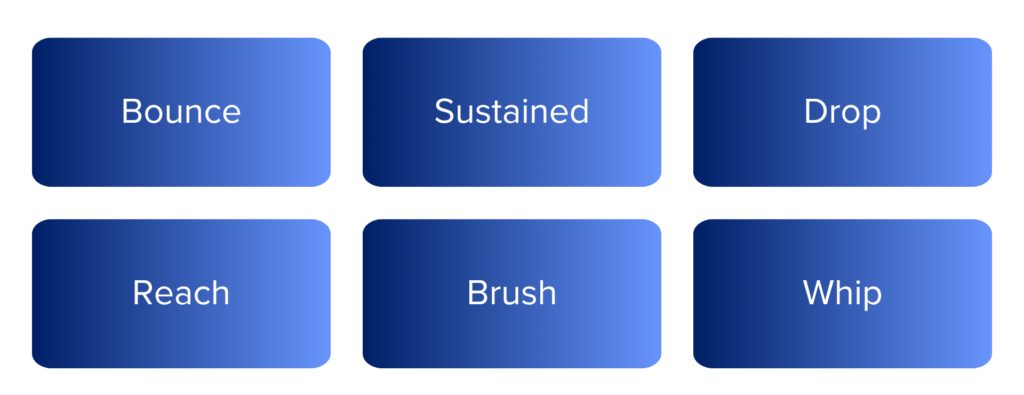
Dynamics describe how a movement is carried out. While most movements can be performed with almost any part of the body, the defining qualities of each dynamic remain consistent regardless of where they are applied. Below are the 15 dynamics most commonly used in Tanztheater:
How it works
| Swing | Down & heavy, needs a hinge | Flick | Quick and small swiping motion | Throw | Heavy and outwards |
| Punch | Quick acceleration, quick stop | Melt | slow muscle relaxation | Push | Outwards against resistance |
| Accent | Quick muscle contraction | Suck | energy gets sucked into smaller area | Pull | Inwards against resistance |
| Bounce | Drop → rebound up → drop | Sustained | Consistant speed and muscle tension | Drop | Let go of tension in one go |
| Reach | From full extension reach even further | Brush | Contact → accelerate → lose contact | Whip | Very relaxed muscle and very quick acceleration |
Below is a video that brings together all 15 Dynamics and the Principles. In this example, the Principles are used to generate movement — but they also serve another purpose:
Principles
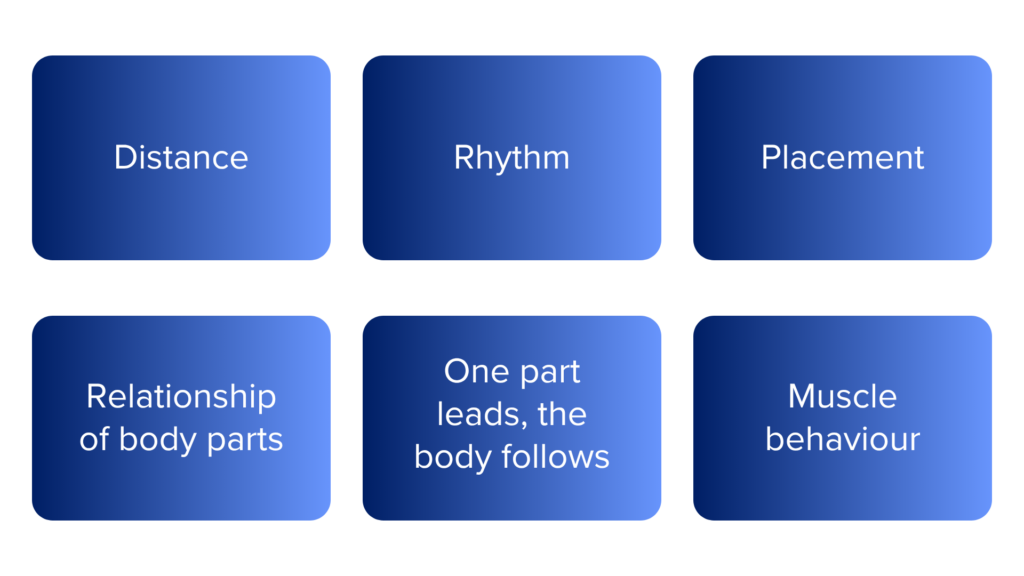
Principles can be used to generate movement (as shown in the video), but they also function as tools for polishing a dance phrase — making it more refined, more versatile, and more coherent.
These are the 6 Principles most helpful to Tanztheater:
How it works
Principles serve as compositional guidelines when reviewing choreography with a detailed, final eye, almost like giving a text its last proofread. You might notice an arm that doesn’t relate clearly to the upper body, a leg that feels disconnected, or foot placement that is inconsistent. These final adjustments, made through the six principles, transform a phrase into a fully embodied experience for both performer and audience.
Muscle behaviour includes of:
→ Relaxation
→ Elongation
→ Resistance
Here is a short demonstration of how Principles and Dynamics might look like in a phrase or exercise:
Time to Play
Click the link or scan the QR Code for our Tanztheater Generator created by long time student Billy Gigurtsis. 
You can select:
→ Number of dynamics or principles to generate (item)
→ Type of item to generate (dynamic, principle, or both)
→ How many principles you want inbetween each dynamic
(when type Dynamic and Principles is selected)
→ The speak delay
(how long in seconds it will wait in between saying each dynamic or principle).
Kinesphere
The Kineshpere in dance is an imaginary, bubble like space immediately surrounding the body. Like a personal aura, it moves wherever the dancer goes.
How it works
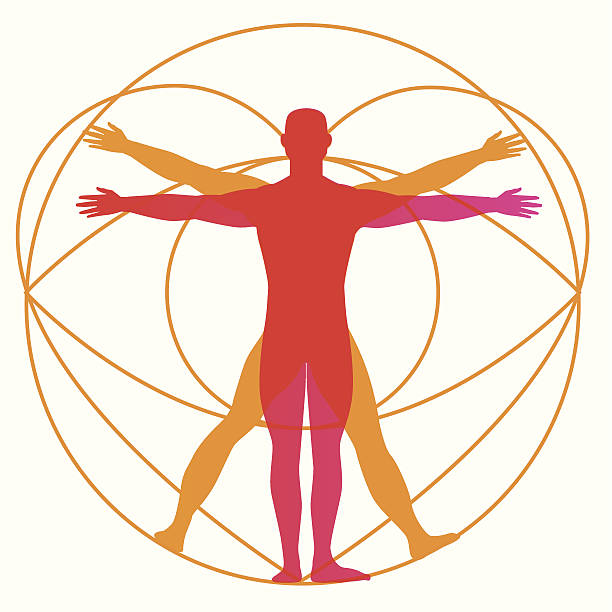
We are always in dialogue with the space around us, so cultivating a clear relationship with that space is essential. It shows that we are part of something larger, not confined to our own bodies or absorbed solely in our movements.
In Tanztheater, we invite the space, tease it, push it, resist it, and respond to it in whatever way the emotional state requires. Try to converse with the space as you perform your phrases. Shifts in direction, combined with a precise sense of how you engage with the space, will deepen embodiment and create a more immersive experience for yourself and the audience.
| Use | Purpose |
| Push the space | Shows an inner conflict and a need for expansion. The air around you feels heavier and you push against it |
| Take the space | You almost ‚gather‘ the space or collect it. Shows a desire to absorb. |
| Through the space | Cut through the space with your limbs or run through it with your whole body. Plays with the idea of deviding. |
| Tease the space | Creating swirls, crafting clouds, brush or blow away the air around you. Ways to play are plenty. |
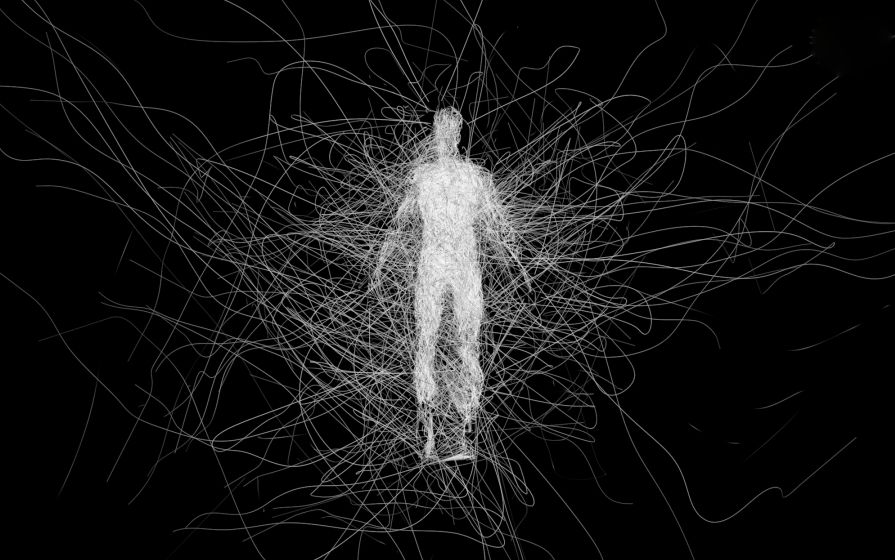
Improvisation
3 – 5 ways
A useful tool for generating multiple variations of the same task. In creative work, we often default to a spontaneous first version and then maybe try its direct opposite. Being asked to produce several versions pushes you to look beyond those obvious choices and discover what else is possible. It’s also an effective way to build a large amount of material quickly.
How it works
Some examples of what could be asked:
Find 3–5 ways to …
| Physical Action | … fall | jump | turn … Punish yourself | Elevate yourself … be gentle | be impatient |
| Metaphysical | … manipulate a mind |
| With Partner | … bring someone from A to B … resist help … pull someone in and lift them |
Include XYZ
A wonderful tool for generating material that highlights Tanztheater’s three core lenses:
Confusion, Friction, and Contradiction.
Working with five distinctly different elements tends to produce the most varied and relatable phrases, aligning beautifully with Tanztheater’s two central sentiments:
Pity and Dignity.
In this task, dancers aren’t asked to choose just one element—they must incorporate all five into a single phrase. The order, structure, and duration of each element remain entirely up to the dancer.
How it works
Some examples of what could be included:
| Action | Manipulate yourself into a caress |
| Task | Count your ribs while walking backwards |
| Technical | Create 5 movements with 5 different dynamics |
| Imagery | Dance through a light rain communicating with as many raindrops as you can |
| Philosophical | Gather something from the outside and let it flourish within |
Expressing a state
This tool encourages the freedom of expressing a physical, mental, or emotional state in its simplest form. Inspiration can come from anywhere—images, videos, paintings, poetry, or other written texts.
How it works
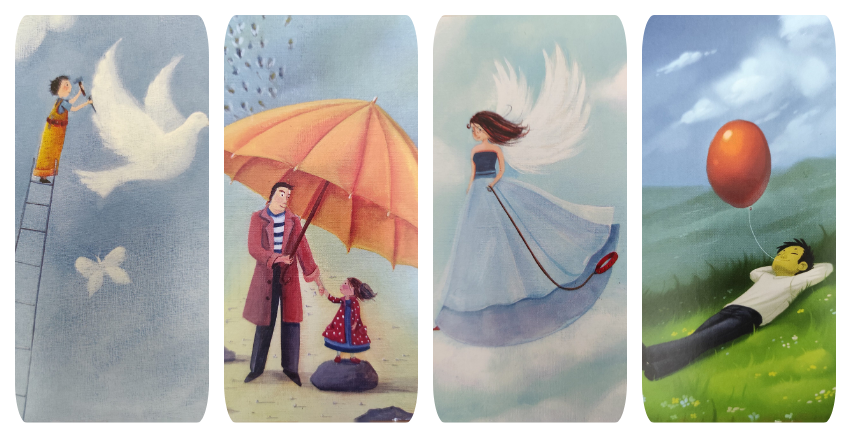
Dixit cards are especially helpful for this: their richly detailed illustrations invite interpretation, making it easy to translate the depicted state into movement and embody it fully
Scan the QR code for more images or click this link.
Questioning and Answering
Intuition + Deep Analysis
The most vital relationship to understand — and eventually to master — in Tanztheater is the one between Intuition and Analysis. When these two forces are allowed to stay in continuous dialogue — supportive, probing, and mutually challenging — you begin to position yourself with a clear artistic stance and a heightened awareness of your own presence which will make it much easier to answer Tanztheater questions.
So keep this in mind for all the theory that follows.
How it works
Intuition
Pros:
→ initial, spontaneous, emotionally instinctive movements
→ image‑driven
→ essential, honest and free
Cons:
→ harder to reproduce
→ difficult to discover new variations or movements
Analysis
Pros:
→ precise, aware and articulate
→ imind-forward approach
→ zooming in
Cons:
→ difficult to navigate through
→ takes more time, patience and effort
Within Tanztheater philosophy, we believe deeply that neither intuition nor analysis is sufficient on its own. For the strongest results, the analytical process stays in constant conversation with your intuition.
Authentic movement emerges only when both are present — continuously, and in dialogue.
What is it made of?
The most fundamental advice for creating meaningful answers is to ask yourself one simple question: What is it made of?
In Tanztheater, answers are never right or wrong. Instead, their quality is measured by authenticity. Authentic answers are those that draw on as many facets as possible of your own unique ways of thinking and feeling.
How it works
Our best friends in Tanztheater are descriptice adjectives. The more precisely you can describe all the elements that shape a particular feeling, thought, state, desire or memory, the easier it becomes to translate them into movement.
Tanztheater is not driven by narrative, meaning it doesn’t rely on a continuous storyline to create coherence or meaning. Instead, it draws on the key building blocks and fragments that shaped significant moments in your life. We focus entirely on these fragments and describe them in as much detail as we can recall.
Some examples:
| Story | Detailed fragment |
| An important memory: I was drinking wine with my family and we laughed so much that night. | I am lightly intoxicated, utterly relaxed yet carefree and excited. The rushing sensation of joy and an energy connecting me deeply to loved ones creates a strong yet contradictory sensation of fully embracing the moment and the soft heaviness of striving to hold on to something beautiful before it disappears. |
| I was holding the door for the most beutiful person I have ever seen and they didn’t even thank me. | A simple, thoughtless act of polite courtesy followed by a burst of a thousand needles. My brain, flooded with fairytale imagery and burdening self‑doubt, causes an exhilarating nausea of future and past. The only harsh salvation is a despicable act of arrogant ignorance keeping me just sane enough to not lose myself. |
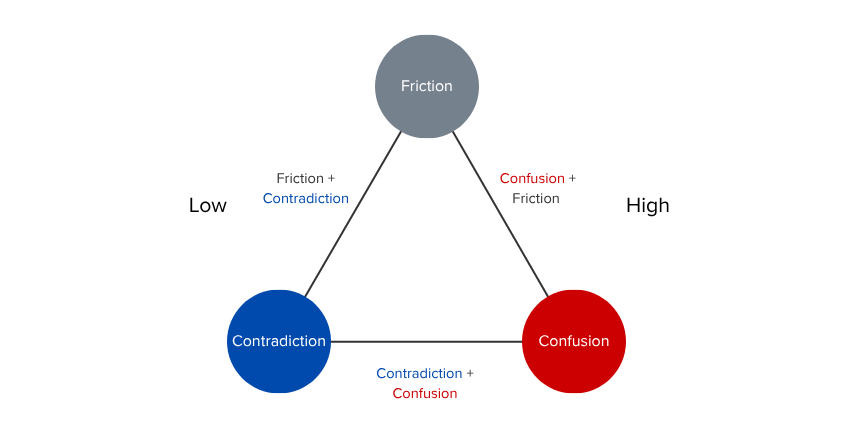
The Three Lenses
When we look at human existence—and especially the human form that has fascinated us since the dawn of art—it can ultimately be traced back to one of these three tension states:
→ Friction
→ Contradiction
→ Confusion
How it works
Friction, Contradiction and Confusion are lenses which means we do do not always experience them in strong amounts.
A low level of confusion becomes clarity, low level of contradiction becomes inner harmony or unity and a low level of fruction becomes flow or smoothness.
Here are the possible combinations these three can create:
| High | Combinations | Low |
→ Explosive inner conflict | Friction + Contradiction | → Harmonious propulsion |
→ Spiralling disorientation | Contradiction + Confusion | → Unshakeable centredness |
→ Agitated uncertainty | Confusion + Friction | → Effortless precision |
Speed of Thought + Power of Small Units
Now seems like a good time to remind ourselves that everything that appears complex can always be broken down into many much simpler, smaller units.
So even the most complicated storyline, the most intricate combination of our three lenses, or a difficult, extended choreography sequence can all be reduced into small, manageable, and helpful pieces.
How it works
Speed of thought describes how quickly we can process information while moving. Assigning supportive thoughts, images, or sounds to a movement as we perform it helps enormously with remembering both the action and its intention.
The smallest unit refers to breaking every movement or action into small, manageable parts.
Together, these two ideas prevent us from becoming overwhelmed. Try giving each small unit simple, clear instructions:
→ What is the movement?
→ Which thought, image, or sound accompanies it?
→ What is the intention?
→ What is the rhythm, count, or musicality?
The Essence Filter
One of Tanztheater’s greatest strengths is its immediate relatability. Even though the work often begins from a deeply personal place, it never collapses into self‑absorption. It is self‑centred in origin, but not selfish in intention. The key is learning to lift the core of your own thought or feeling into a wider human frame so it resonates beyond your individual experience.
A useful way to ensure your answers don’t stay locked inside your own perspective is to relate the essense of your individual thought or feeling to the bigger picture. That’s precisely what the Essence Filter is designed to support.
How it works
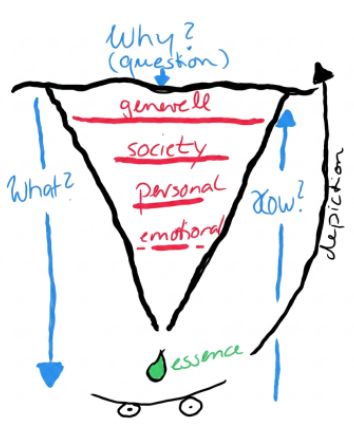
Based on the Why—the question or statement you begin with—you move through each layer of the filter by asking: What is compelling enough to keep, or worth exploring further? As you descend through the layers, the number of possibilities naturally narrows. By the time you reach the final layer, you’re left with a single concentrated drop of essence: the distilled core of what was important enough to keep throughout.
The How is the return journey—how that distilled essence comes back up to the surface and takes form. This is where you shape it into movement, text, or imagery, using any of the other tools in this course to help you give it structure, clarity, and expression.
| Layer | Description |
| General | On the general level, almost anything is possible. Stay open, follow impulses, trust intuition. You might draw from a memory that sits years in the past, or let your current mood lead the way. |
| Society | Whatever caught your attention at this broad level and felt worth exploring, the next step is to ask how it connects to other people. This can range from everyday social interactions and community dynamics to large‑scale relationships between groups—politics, culture, conservation, and beyond. |
| Personal | From there, you narrow the focus to your personal position within that landscape. Are you an active protagonist or a passive observer? Does the situation touch you directly, or does it affect someone close to you instead? |
| Emotional | Finally, you ask: How do you feel about it—and even more importantly, what does that feeling do to you? |
The Microscope Idea
For more complex or longer Tanztheater questions, there are four steps that help you avoid getting lost in the maze of words and keep your answers individual and real.
These four are:
→ Focus
→ Perspective
→ Presentation
→ Percentage
How it works
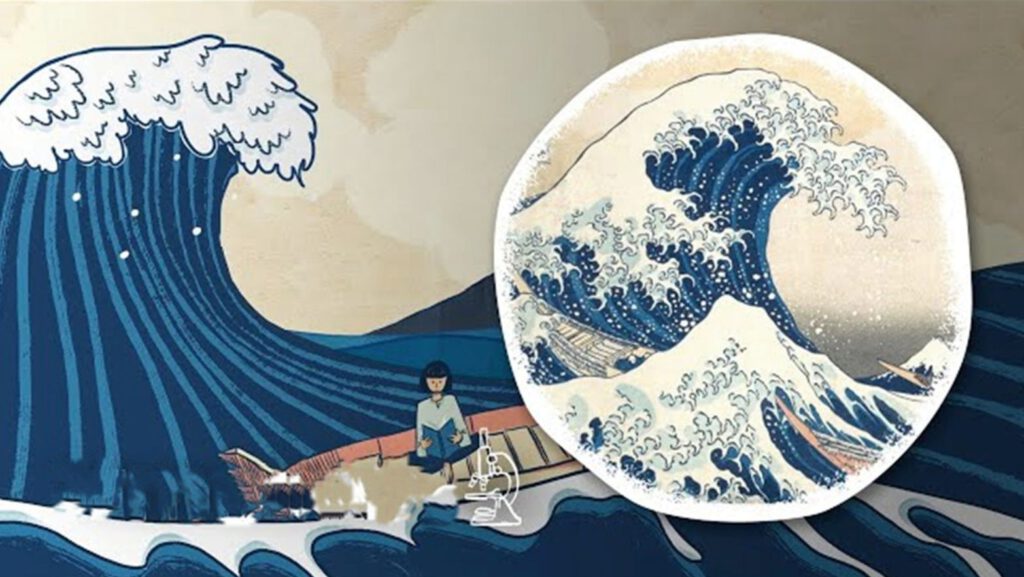
Let us use the below picture and this sentence as an example:
A wave of destructive curiosity
| Explanation | Choices | |
| Focus | Choose the area you want to focus on → | 1) wave 2) destructive 3) curiosity 4) relationship between all three |
| Perspective | What is your position or role in this? → | Do you observe or do you experience? |
| Presentation | How do you present this to an audience? → | Reflected or Animalistic* |
| Percentage | What are my combinations (Three lenses) → | Friction, Contradiction, Confusion |
*The reflected approach aims to create the feeling of sharing something from the past — something already processed, understood, and carried with a sense of distance. Gestures are often used to convey this reflective quality.
The animalistic approach, on the other hand, seeks to show an action or movement as if it is being experienced for the very first time, right here in the present moment.
Idea to Body
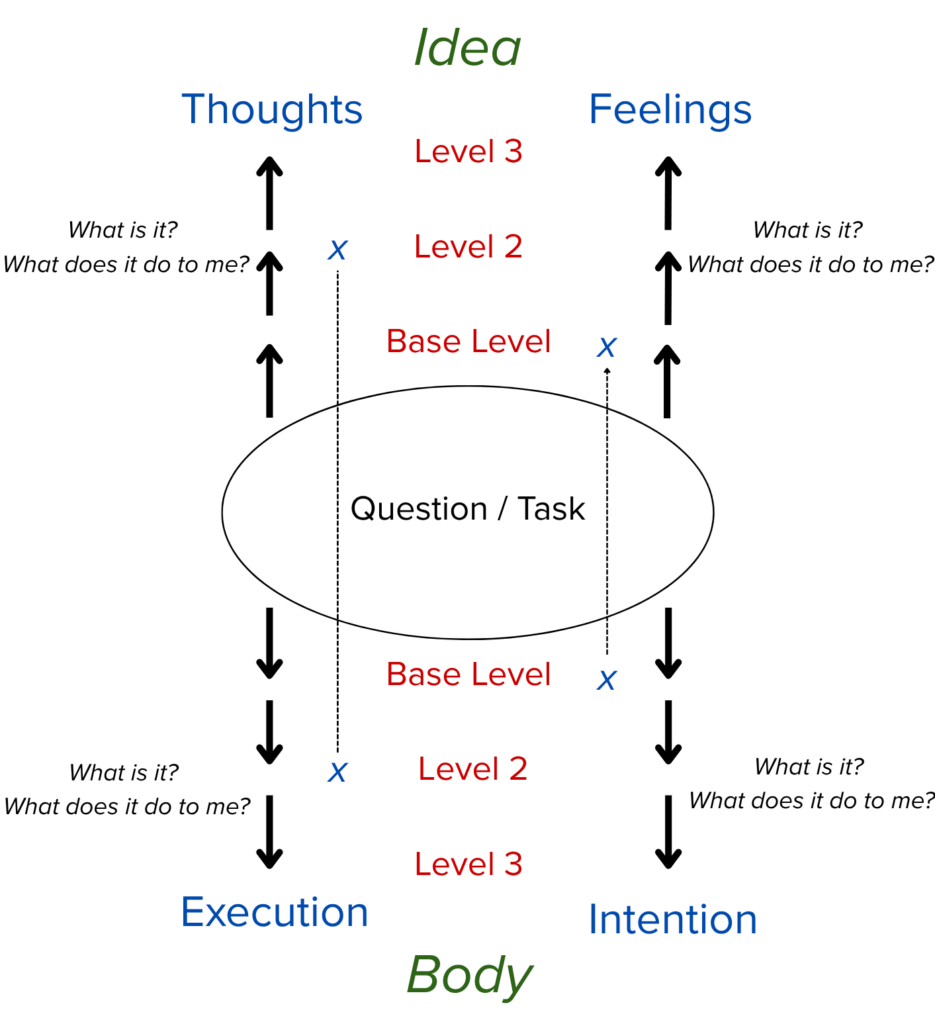
The transition from Idea to Body focuses on how you can find a matching intensity through your improvisational research.
For this to work we make the following destinction:
Idea
→ Thought or Feeling
Body
→ Execution or Intention
How it works
From the body’s perspective, we look at the distinction between Execution and Intention—how a movement is carried out versus what drives it from within. An Idea, meanwhile, can originate from either a Thought or a Feeling, each offering a different kind of impulse or direction.
The depiction above illustrates how these elements connect through the interplay of body and idea.
In simple terms:
The intensity of the execution should match the intensity of the thought, and the intensity of the intention should match the intensity of the feeling.
Example:
My last first kiss.
You might feel a base‑level feeling in response to this sentence. Let’s say that feeling is hope. Because the feeling sits at a base level, the intention it generates will also sit at a base level. In this case, hope might naturally carry an intention like brave caution — a gentle willingness to move forward while still protecting yourself.
That intention can then spark a deeper thought (level 2). For example: Maybe I should wait a little before I act. This deeper thought will, in turn, activate a corresponding deeper level (2) in your execution. So even though the original feeling was only hope, the cross‑referencing between the four elements — feeling, intention, thought, execution — results in a more layered, more complex but also more authentic action.
This dynamic can unfold in many different ways, but building a relationship between these four layers helps you understand how a simple spark can evolve into a richer, more intentional response.
Lastly, when you find yourself moving through this maze, let two simple questions guide you:
1) What is it? ( Thought, Feeling, Intention, Execution )
2) What does it do to me? (what else follows from this?)
Theory
Creating Questions
In Tanztheater, the most powerful questions are often the ones that don’t immediately “make sense,” because their ambiguity encourages the performer to take a position and respond with genuine honesty rather than safe, surface‑level answers. A good question creates an opening—something the performer can link to a broader theme, inhabit as a distinct state, and express through a clear, personal example.
How it works
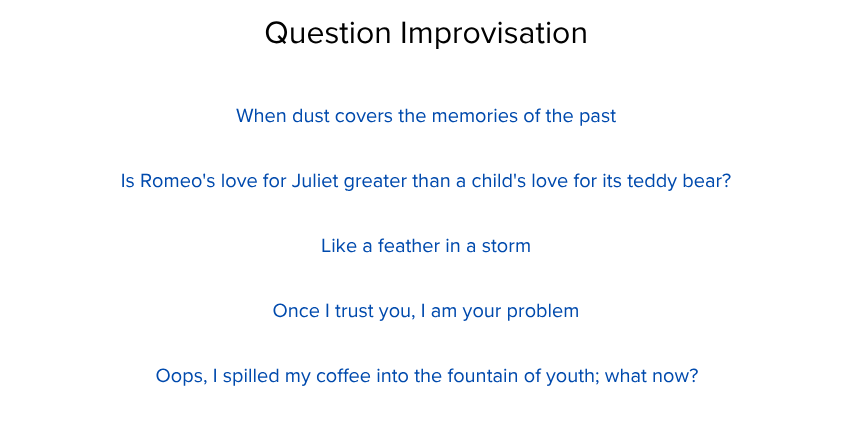
Questions
When dust covers the memories of the past
Is Romeo’s love for Juliet greater than a child’s love for its teddy bear?
Like a feather in a storm
Once I trust you, I am your problem
Oops, I spilled my coffee into the fountain of youth; what now?
When creating – and especially when answering Tanztheater questions – try to relate the prompt to these four elements:
Theme
↓
State
↓
Example
↓
Question | Task
↓
Idea
| Theme | Realm | Control | Quirky humour |
| State | Lost | Powerless | Free | Embracing disaster |
| Example | A person tumbling and falling in loose movement quality | Messing up in globally important situations. |
| Question | Task | Like a feather in a storm | Oops, I spilled my coffee into the fountain of youth; what now? |
| Idea | Thinking of all obligations in everyday life and just surrendering to them. Assign quality words to each obligation (what is it made of?) and create small squences for each, then put everything together. |
|
System for Creation
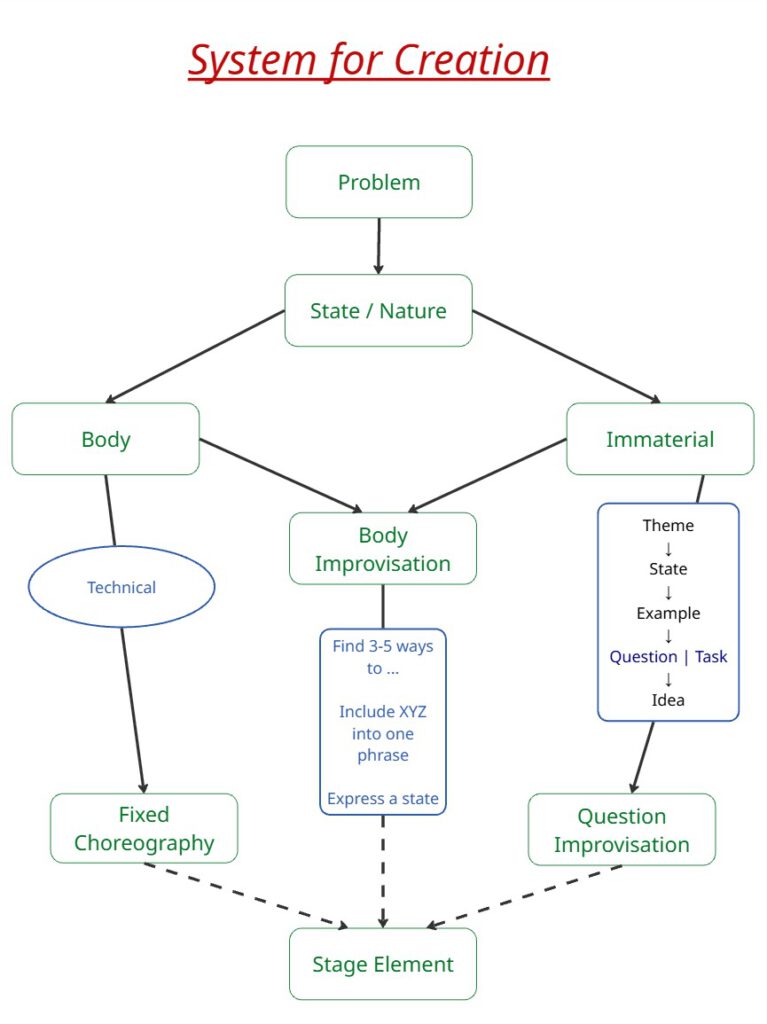
The system breaks the creation process into three core areas that give you an initial anchor. From there, you can explore each area more deeply through Technique, Improvisation, or Questioning and Answering, depending on which pathway serves you best to develop your material.
How it works
The system begins with the fundamental challenge every artist faces when creating something new: it starts from nothing. The task, therefore, is to generate a staged element out of that void. To do this, you first identify the state or nature of the problem. Through that process, you’ll recognise that the problem falls into one of three areas:
→ Body
→ Body Improvisation
→ Immaterial
(Questioning and Answering)
From here you follow the pathway for the outcome you want in your staged element.
The When to Use What and the ACT Triangle will clarify this further.
When to use What?
A quick guide to which element of the system creates the most direct results, depending on what you’re aiming for.
How it works
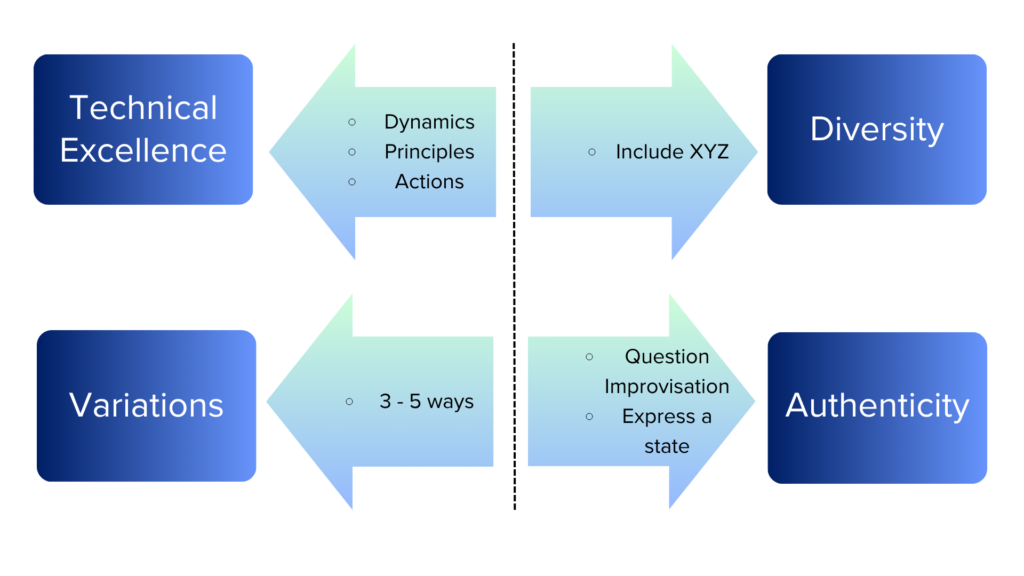
If your element requires technical excellence and you already know the vibe and choreographic language, create the choreography yourself—drawing on Dynamics, Principles, Actions, or any other technical attributes that support your idea.
If you want diversity and need to portray the three lenses, use XYZ.
For many variations of one idea, work with 3–5 Ways.
And if your main focus is authenticity, choose the Question Improvisation or
Express a State pathway.
ACT Triangle
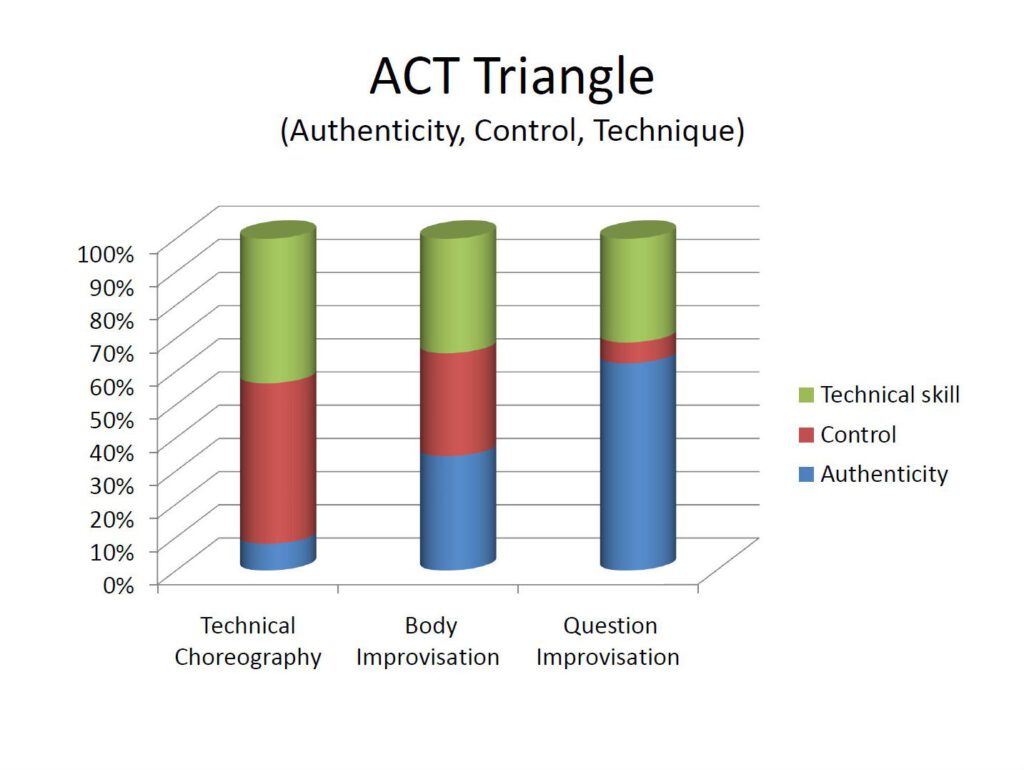
To help you choose the most effective pathway for the staged element you want to create, consider the strengths and limitations of each option through three criteria:
→ Authenticity of the performer
→ Control you have as the creator
→ Technical skill that will be showcased
How it works
Both the Body and the Question Improvisation pathways rely heavily on trust—and each can elevate the other. The more dancers trust that the choreographer is pushing them toward a richer technical vocabulary, the more versatile and articulate their movement becomes. Likewise, the more the choreographer trusts the dancers to answer questions authentically, the more freedom and genuine safe space emerges. Body improvisation is a powerful, adaptable pathway, but it can sometimes miss that extra spark that makes a scene truly compelling; it often generates a wide range of material and fragments that work beautifully as connective or supporting elements.
| Body (technical) | Body Improvisation | Question Improvisation | |
| Technical skill | very high | high (but not top priority) | medium to high (but even less important) |
| Control | very high | high | very low |
| Authenticity | very low | high | very high |